Web apps
Full OWASP-guided testing of authenticated web applications.
Point PentestPilot at a target and it runs the whole engagement on its own — recon, exploitation, and multi-agent AI validation — across web, APIs, networks and source code. Every finding is gated by a verification rule enforced in the database, not a prompt. So what reaches your report is real.
Traditional scanners bury your team in "possible" findings to triage by hand — most of them noise. Human pentests are accurate but slow, expensive, and stale the moment you ship again. You're stuck choosing between fast and wrong or right and rare.
Output quality is the whole game in automated pentesting — false positives are why teams abandon these tools. So we made quality a structural property, not a prompt. Each candidate vulnerability is fought over by independent AI specialists, and the final "verified" state is guarded by a constraint enforced in the database itself.
Triages each candidate, reproduces the request, and drops anything that doesn't behave like a real bug.
Attempts a working exploit and captures concrete evidence — responses, banners, extracted data.
Exactly one adversarial specialist — Fighter (web exploit), Airline (logic & config) or Jet (infrastructure) — tries hard to refute it. It survives only if they can't.
A PostgreSQL trigger (iron_rule_vulnerability_check) rejects any "verified" write without a consensus of specialist TRUE_POSITIVE verdicts.
A false positive can't be marked verified — not by a bug, not by a bad prompt, not by a rushed run.
The guarantee lives in PostgreSQL, so it holds even if everything above it fails.
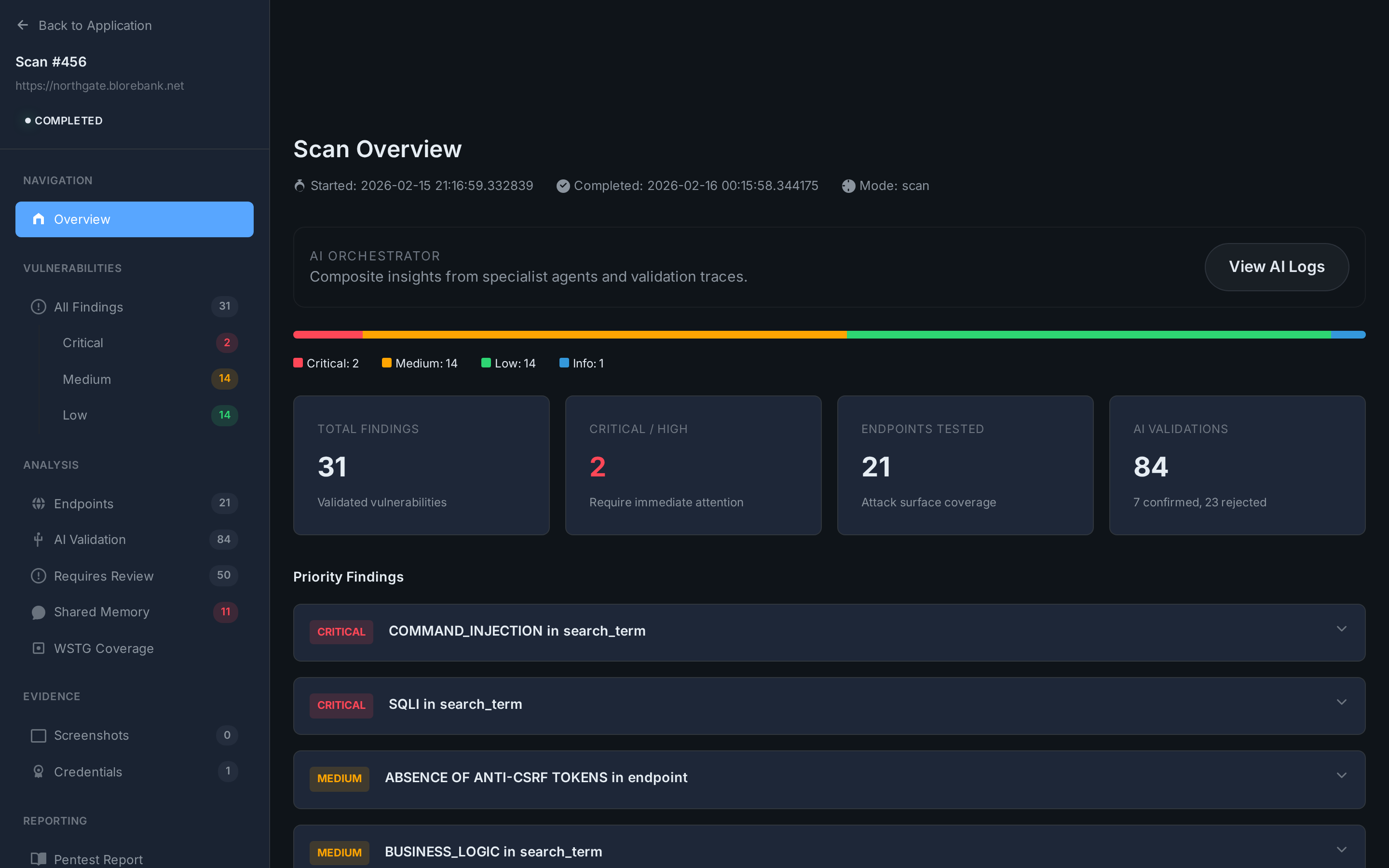
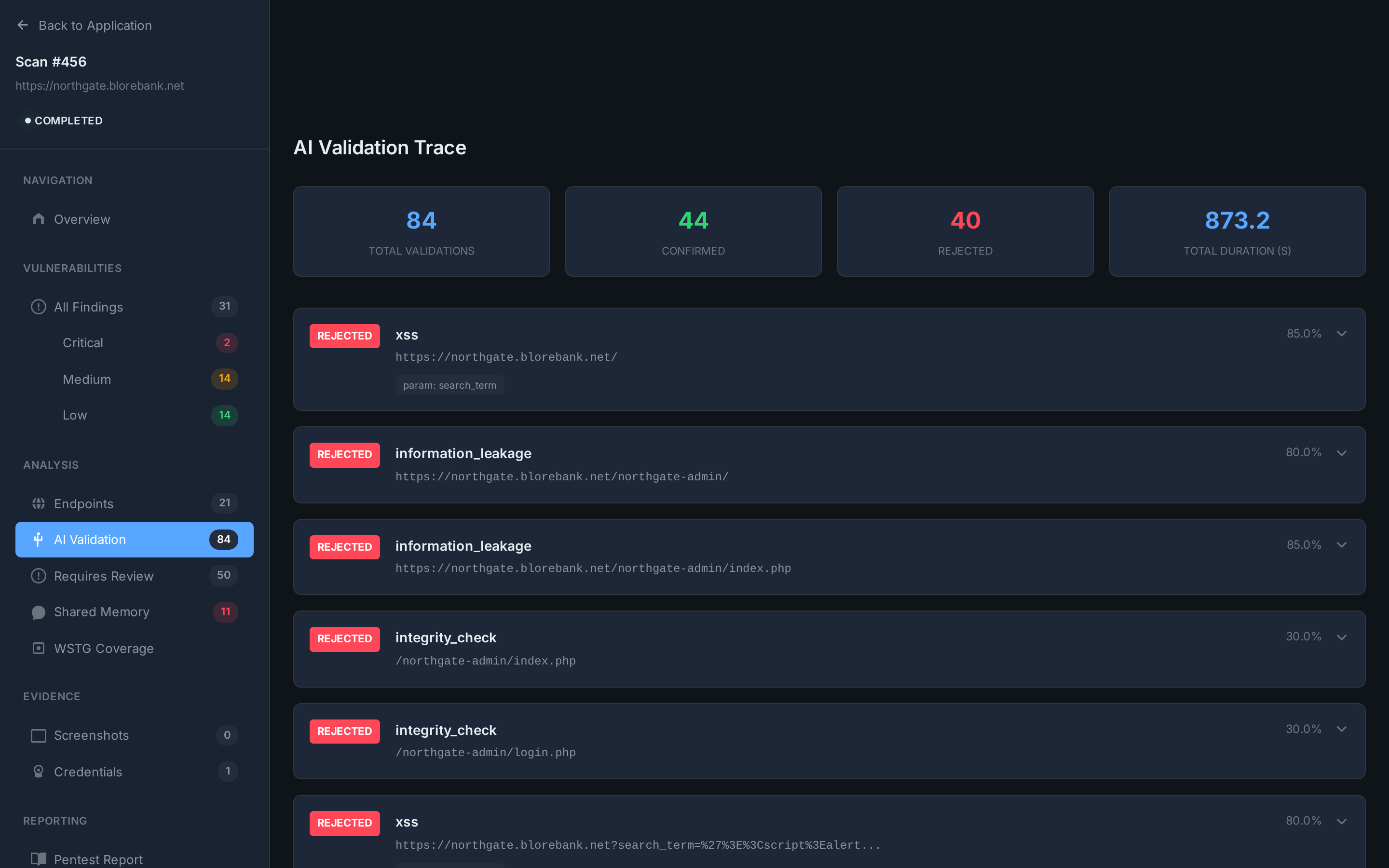
In the scan on the right, the validation chain reviewed 84 candidate findings and rejected 40 of them outright — the noise never made it to the report.
Point it at a target. It plans, tests, validates, and writes the report — you review verified findings, not a triage queue.
Capture sessions, crawl and map the attack surface — endpoints, parameters, auth flows and tech.
Rank every injection point by how input is reflected, stored, or executed to focus the test.
Drive real tools — SQLMap, Dalfox, SSTImap, Nuclei and more — at the ranked targets.
Copilot investigates, Pilot routes, and one specialist proves or kills each candidate — with evidence.
Systematically walk the OWASP WSTG so nothing in scope is silently skipped.
Autonomous agents chase business-logic flaws, chain findings, and expand the surface as they learn.
A clean report of verified findings — severity, CVSS, evidence and reproduction for each.
The same engine and the same quality bar, wherever the risk lives.
Full OWASP-guided testing of authenticated web applications.
REST and GraphQL surfaces, with schema-aware injection testing.
External infrastructure and exposed services across a range.
Repository scanning that ties code weaknesses to live exposure.
Point it at a program's scope and let it hunt, end to end.
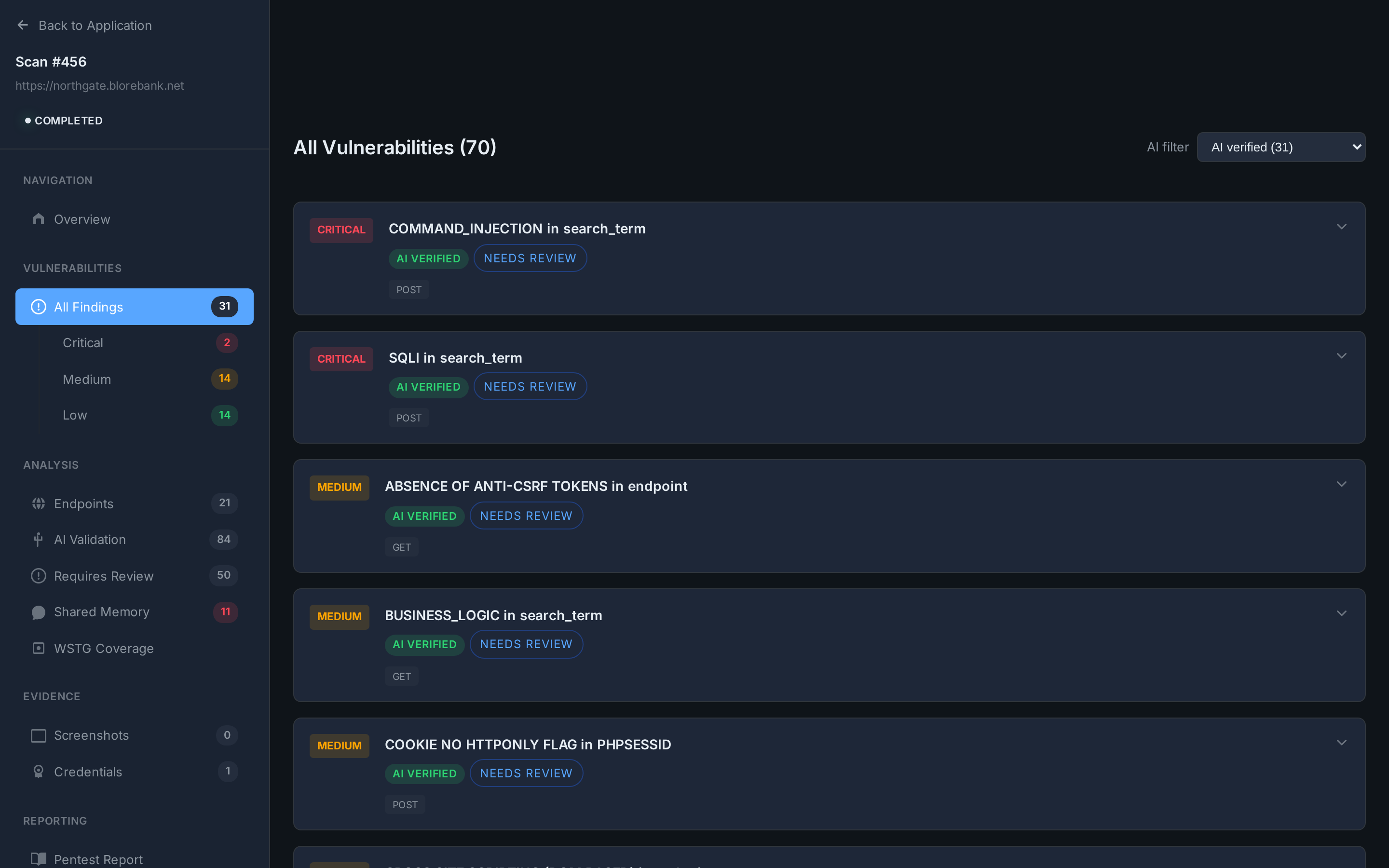
Findings carry an AI VERIFIED verdict, the request method, the exact parameter, and the evidence behind them — filter straight to what's confirmed and skip the noise.
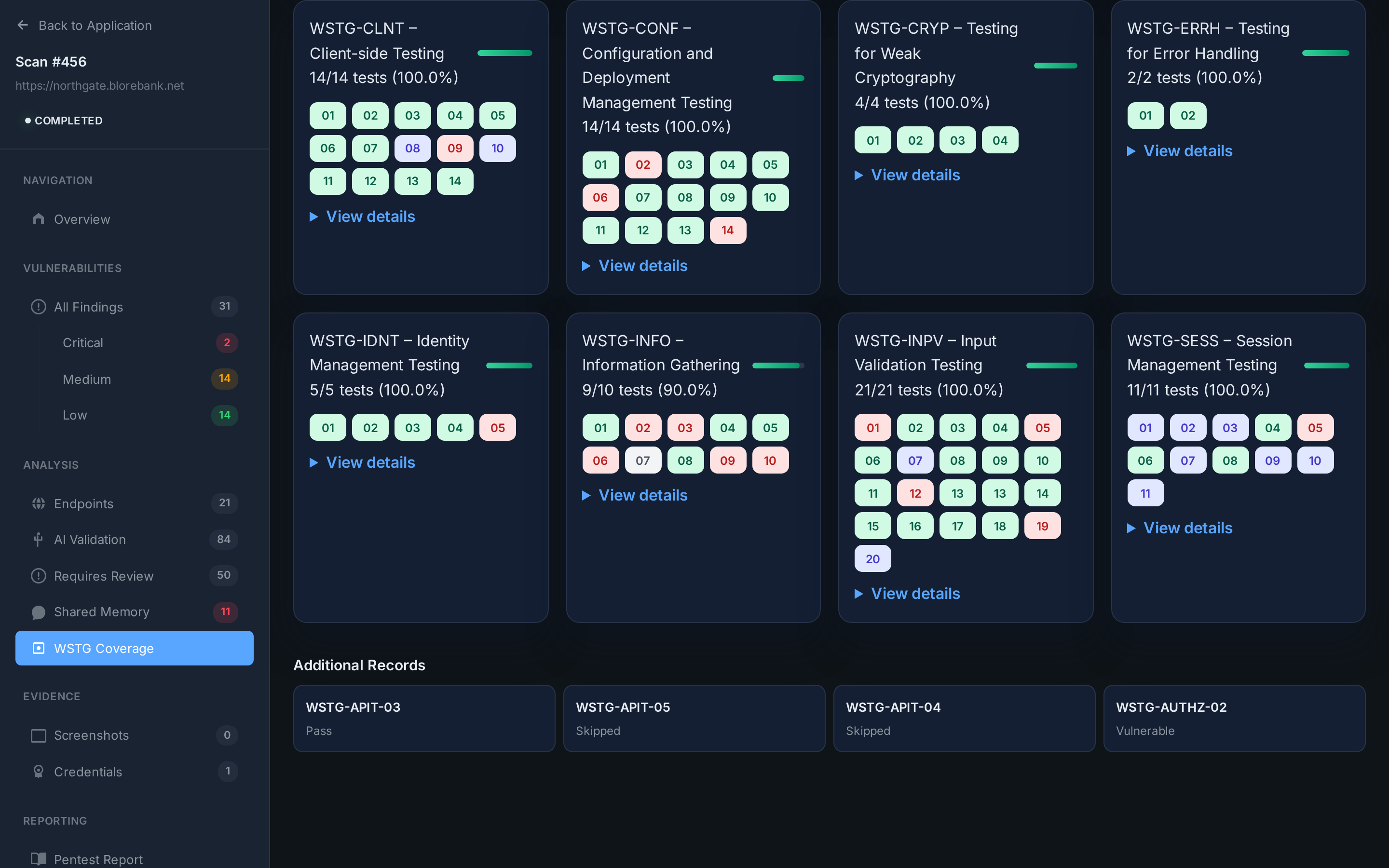
PentestPilot walks the OWASP Web Security Testing Guide category by category and shows you exactly which test IDs passed, failed, or were skipped — so coverage is provable, not assumed.
~30 open-source tools — SQLMap, Dalfox, Nuclei, SSTImap, Nmap, ffuf, ZAP, testssl.sh and more — orchestrated, not reinvented.
Run on Anthropic Claude, OpenAI, or a local Ollama model — your keys, your choice.
Risk scoring, critical attack chains and business impact — not just a list of bugs.
Severity, CVSS, evidence and reproduction, packaged for the person who has to fix it.
Track what changes over time and re-test what moved, instead of re-scanning everything.
A security tool held to the standard — hardened, self-hostable, your data stays yours.
The exact same engine runs single-tenant on your host or multi-tenant in the cloud.
Single-tenant, on a host you control.
# start the stack (Docker Compose)
./startup-docker.sh

# then open Mission Control
http://localhost:8080
Multi-tenant SaaS — nothing to run.
Point PentestPilot at a target you own and watch it discover, exploit, and prove — with zero noise to triage. Request access and we'll get you set up.
Prefer to self-host? Start with the Docker quickstart.